You Know How Al Gore Invented the Internet
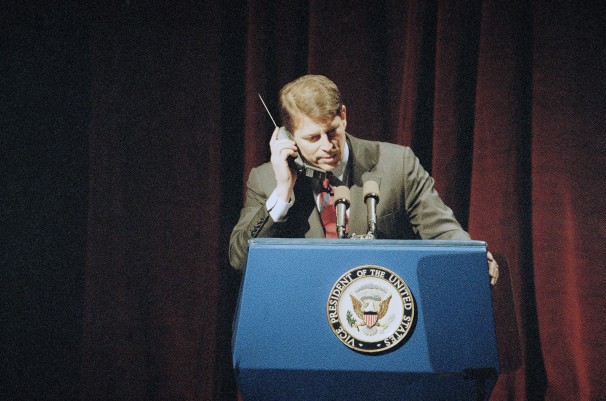
The Truth Virtually Al Gore Inventing The Net
Every bit you know, often on this podcast, I run across issues or tidbits from the past that don't quite fit our overall narrative. But sometimes those tidbits are just too interesting for me to ignore. 1 of those things I go along running across is Al Gore and his role with the early Internet.
I call up it'south something that we all sort of "know." That Al Gore claimed he invented the Internet. I call up this being a pocket-size political issue at the time of the 2000 election, but I honestly never cared enough to investigate the details. Concluding weekend, nonetheless, I went down a research rabbit-hole and decided to find out the truth. Not because I'm a huge Al Gore fan, or because I'm looking to score points against him either. I was just genuinely interested, and wanted to find out the historical truth— not but the partisan-tinged conventional wisdom.
Then, here is what I found out.
(BTW… this is transcribed from a podcast episode, which you lot can mind to beneath…)
Al Gore, Nerd

Clinton and Gore Installing Fiber Optic Wire
Every bit I've mentioned in a previous podcast, when the Clinton/Gore ticket was commencement elected in 1992, one of their large platform initiatives was the employ of calculator and digital technology to create new jobs and new industries that would help the country innovate its way out of the sharp recession it was experiencing at the time. Gore was very much put forth as the front man for this new geek-based economy push. In fact, simply a few short days after the election in November 1992, The New York Times ran an commodity with the title, "Clinton to Promote High Technology, With Gore in Charge."The article stated that the administration wanted the regime to finance research "that volition alluvion the economy with innovative appurtenances and services, lifting the full general level of prosperity and strengthening American manufacture."
Indeed, the Clinton administration followed through with various bills to this outcome. And in fact, Gore himself was often involved in many net and web firsts. Gore became the first Vice President to requite a live interactive news briefing on a calculator network. The first always White House website was launched equally early as October 21, 1994, two months before Netscape version one.0 was even launched. As a part of Gore'southward high-contour projection to streamline authorities bureaucracy, Federal Government agencies were encouraged to use the web and internet to cutting down on waste material and redundancy. And so there was Gore's interest in the infamous Clipper Fleck initiative, which I discussed in that previous episode.
But it turns out, Al Gore has always been touted as a bit of a nerd. From his start days in Congress in the 1970s, Gore tended to gravitate toward scientific and technological issues, sponsoring and co-sponsoring tech and science bills, as well as seeking assignments on Congressional and Senate committees that oversaw such bug. Describing a young Congressman Gore, a Wired article said, "Before computers were comprehensible […] Gore struggled to explain artificial intelligence and fiber-optic networks to sleepy colleagues." And the book Computer: A History of the Data Machine
In fact, Gore was often lumped in with a group of young lawmakers who were referred to at the time every bit "Atari Democrats." The San Jose Mercury News defined Atari Democrats as, "smart young congressmen who sought to brand the restoration of American business their issue." An article in the New York Times referred to Atari Democrats equally, "young moderates who saw investment and high technology as the gimmicky reply to the New Bargain."
An of import affair to retrieve is that Gore was the son of a famous Senator, Albert Gore Senior, who was one of the principal congressional architects of the Interstate Highway System, which was begun during the Eisenhower administration in the 1950s. So, when Al Gore Jr. began investigating the possibilities of nationwide reckoner networking systems (for case, introducing S 2594, the Supercomputer Network Study Act of 1986) it's probably natural that he saw echoes of his father's achievements linking the country together via roads. Information technology's unlikely that Al Gore coined the phrase "data freeway" himself, but he certainly popularized the phrase in speeches and bills he introduced in the 1970s and 1980s. His vision was that citizens around the land could be linked together via calculator highways but as his father had linked them together with car highways.
And this brings usa to the key event that ties Al Gore to Internet History, for better or worse. In 1988, a grouping led by UCLA professor of informatics, Leonard Kleinrock submitted a paper to Congress entitled Toward a National Inquiry Network. Kleinrock was 1 of the original creators of ARPANET, besides as the writer of the very get-go scholarly paper on package switching theory. The paper Kleinrock's grouping presented to congress in 1988 envisioned taking the existing Internet to another level by creating a national, collaborative research network. Sort of what Tim Berners Lee would somewhen realize with the World Wide Web. Inspired by this paper, Gore would introduce the Loftier Operation Computing and Communication Act of 1991. The bill was intended to funnel federal dollars toward continued research in loftier performance calculating and networking. The legislation was unremarkably referred to as the "Gore Bill" and when the kickoff President Bush signed it into police on December ix, 1991, he stated that the act would help, "unlock the secrets of Deoxyribonucleic acid," amidst other technological innovations.
Amongst those other innovations, the "Gore Bill," helped fund important predecessors to the spider web, such as the National Data Infrastructure and the National Research and Education Network. For our purposes, especially cardinal among those other innovations was funding for the National Center for Supercomputing Applications at the University of Illinois. As yous'll remember from the very first episode of this podcast, the NCSA was where the Mosaic web browser was created. So, every unmarried i of the engineers responsible for creating the Mosaic web browser were receiving salaries cheers to the "Gore Bill." In fact, none other than Marc Andreessen gave credit to Gore'south bill equally a kickstarter for web evolution in an Industry Standard interview from 2000, proverb, "If it had been left to private industry, it wouldn't have happened, at least, non until years later."
So Gore Has a Case?
Al Gore did not invent the internet, but we can clearly see that he has a instance a) for being a visionary interested in the engineering science that would eventually bring the net into the mod era and b) shepherding technology-friendly legislation through congress that led directly to primal innovations such as the world broad spider web. In fact, none other than Robert Kahn and Vint Cerf, two people who really did assist invent the net, afterward gave direct credit to Gore's legislation equally being a major milestone in Internet evolution and development, maxim:
…there is no question in our minds that while serving as Senator, Gore's initiatives had a pregnant and beneficial result on the still-evolving Net. The fact of the affair is that Gore was talking about and promoting the Internet long earlier most people were listening.
(…)
Every bit far dorsum as the 1970s Congressman Gore promoted the idea of high speed telecommunications every bit an engine for both economic growth and the improvement of our educational organization. He was the first elected official to grasp the potential of computer communications to have a broader impact than just improving the comport of science and scholarship. Though easily forgotten, now, at the time this was an unproven and controversial concept.
(…)
Gore secured the passage of the High Performance Computing and Communications Human action in 1991. This "Gore Human activity" supported the National Inquiry and Education Network (NREN) initiative that became i of the major vehicles for the spread of the Cyberspace beyond the field of information science.
And then, Gore was clearly involved in Internet development, or at to the lowest degree, he marshalled legislation that aided the Cyberspace'south development. Simply he clearly didn't invent the Internet.
Why, then, did he say that he did?
Well, that'south where things go a flake complicated. For ane thing…
Al Gore Never Actually Said He "Invented" the Internet
The interview that generated the quote in question… the quote that would go on to spawn a thousand low-cal night television jokes… comes from this March viii, 1999 CNN interview with Wolf Blitzer:
The key words from Gore:
… During my service in the U.s. Congress, I took the initiative in creating the Internet. I took the initiative in moving forrad a whole range of initiatives that accept proven to be important to our country'south economic growth and environmental protection, improvements in our educational system.
Accent mine. A full transcript of the interview can be plant here.
And so, yes. We tin can become into the whole thought of politicians and their mealy-mouthed doublespeak, merely Gore doesn't really say the famous "I invented…" The problem is, he seems to claim credit for fostering the Net'south evolution. By maxim "I took the initiative in creating the Internet," information technology certainly sounds like he was the wellspring that made information technology all happen. I suppose, depending upon your political bent, you lot could translate what he says in i of 2 ways:
- I introduced legislation that created the internet.
- I introduced legislation that helped foster the evolution of the cyberspace.
Merely what is indisputable is that he doesn't actually claim to be the genius that invented the Internet or fifty-fifty Internet applied science.
 So How Did Gore Get Tagged With This Famous Line?
Well, that's interesting. Just last year, the Washington Post wrote an article entitled A cautionary tale for politicians: Al Gore and the 'invention' of the Internet.
They agreed that the meat of the quote, fifty-fifty allowing for the fact that, "people sometimes misspeak on alive television," seemed to grab credit in a somewhat overly zealous manner.
Quoting the Post:
A gaffe sticks if it somehow validates preconceived notions nigh a politician. Gore had a existent story to tell about existence 1 of the first politicians to grasp the importance of interconnected computers. But with one awkward phrase, spun upward by opponents and misreported by the media, he managed to obscure his accomplishments and instead become a recurring punch line.
And that'south the thing. The whole quote was spun to fit into a mutual media charactarization of Gore every bit a smarty-pants know-it-all, as the snooty professor or moral scold (which of course, the Inconvenient Truth moving-picture show did little to alleviate).
The whole brouhaha really kicked off on March 11, 1999, when Wired News published this article past the writer Declan McCullagh, under the title "No Credit Where Information technology'south Due." McCullagh said that Gore, "took credit for the Internet," and went on to indicate out that Gore was too young to have been around for the creation of ARPANET and claimed, "Gore has taken credit for popularizing the term "information superhighway" (…) But the term "data highway" has been used as far back as 1975, earlier Gore entered Congress." Of course, Gore didn't claim anything about ARPANET or the infohighway, at least not in the interview in question.
Nonetheless, inside days, the tag of the bragging (and possibly fibbing) Gore stuck. This was in the days before blogs and long before the Twitter echo chamber which today pounces on every little political gaffe or meme, ofttimes reliably parsing facts but also bouncing the debate dorsum and along, ad nauseum. I think the fact that the outcome was initially picked upwards by Wired News was an important factor in the evolution of the meme. Again, this was a more technologically naïve time, and lots of "normal" people would have taken Wired as an expert phonation on Internet matters.
On the same day the McCullagh article appeared, Business firm Majority Leader Dick Armey issued a press release that was sarcastically titled "Armey Applauds Vice President Gore for Ingenuity, Creativity and Imagination," that said, in role:
If the Vice President created the Internet then I created the Interstate highway system. Both were begun during the Eisenhower Assistants and I think Ike actually deserves a little credit here.
It's common in Washington to steal an idea and claim information technology was yours all along. This strategy certainly worked for the Administration on welfare reform and taxation cuts. Just challenge credit for the Internet insults its real creators whose hard work and ingenuity can never be stolen.
This was followed by a statement from Senate Bulk Leader Trent Lott:
During my service in the United States Congress, I took the initiative in creating the paper clip.
Lott refused to answer questions about whether or not he was besides the Fifth Beatle.
And past that point, the meme was truly off and running. The thought that Al Gore claimed credit for inventing the Internet near immediately became what it's been ever since: a punch line for tardily-night comedians. It shares this stardom with the questionable claim that Gore and his and so-wife Tipper were the inspiration for the novel and moving picture Beloved Story. (As it's a bit beyond our purview here, I did not investigate the veracity of the Love Story merits equally well.)
The at present-common joke even fabricated it into the Presidential debates of the 2000 election. During a back-and-forth most the adding of HMO coverage in the starting time presidential debate that yr, candidate George Westward. Bush zinged Gore with the line, "Not only did he [Gore] invent the Internet, but he invented the calculator."
Gore himself would often return to the gaffe, many times trying to defuse information technology with sense of humour, "I was pretty tired when I fabricated that comment because I had been up very late the nighttime earlier inventing the camcorder."
Declan McCullagh followed upward with two more pieces in Wired News covering the fallout from the media meme he himself had helped create. It all seemed to fit so well into the, by this point, firmly-established narrative of Gore as the big-headed braggart. Quoting from McCullagh's third piece:
Reinventing yourself — and rewriting your résumé — is a form of high fine art in Washington. And so why the opprobrium heaped on Gore? Simple: He was clumsy enough to get caught.
The problem is, McCullagh himself didn't investigate deeply enough to encounter that, in fact, Gore was responsible for some pregnant legislation that, in the opinion of quite a few Internet pioneers, was quite useful in medium's early on days.
In short, Gore kind of had a betoken, fifty-fifty if he stated it in a, shall nosotros say, over-enthusiastic mode. He kind of did have a mitt in helping the Internet develop.
In his most recent book, The Innovators
No less a partisan than Newt Gingrich (like Gore, a well-known nerd and innovation policy wonk) is willing to let Gore off the hook for the gaffe, saying,
In all fairness, it's something Gore had worked on a long fourth dimension. Gore is not the Father of the Internet, but in all fairness, Gore is the person who, in the Congress, most systematically worked to brand sure that we got to an Internet, and the truth is — and I worked with him starting in 1978 when I got [to Congress], we were both role of a "futures group"—the fact is, in the Clinton assistants, the world nosotros had talked nearly in the '80s began to actually happen.

Gore'south image from the Cyberspace Hall of Fame.
For what information technology's worth, Gore was eventually inducted into the Internet Hall of Fame, but in the category of "Global Connectors" and not in the category of "Pioneers" like Vint Cerf or Bob Metcalfe, and not in the category of "Innovators" alongside the likes of Tim Berners-Lee, Marc Andreessen or even Aaron Swartz.
So In Conclusion, No, Al Gore Did Not Invent The Cyberspace. Only Technically, He Never Said He Did.
In the end, based on what I tin slice together, information technology'south articulate that Gore made a sloppy statement that maybe you don't take to take also far out of context to become the impression he was claiming credit for bringing the Internet to life.
Only here's the thing, at least in my opinion.
Most legislators, fifty-fifty to this twenty-four hours, have very little understanding of technology. They don't really understand how the Internet really works. And I'm not just talking about things like a series of tubes. I'm maxim, our politicians don't have even a base-level understanding of how things like software and hardware and networking and digital engineering actually function in the real world.
And and so, that is why we take such terrible laws governing things like patents.
And copyright.
And net neutrality.
Because, since the legislators don't empathize whatsoever of it on a very bones level… considering it's all weird, geeky mumbo-jumbo to them… they but trust the lobbyists to sympathize and write the legislation for them.
And and then over again, I didn't write this slice to exonerate or attack Al Gore. I don't intendance about what he said on a partisan level. My interests are but historical.
But, I will make this i betoken: information technology's articulate that Al Gore was an gorging and early fan of technological innovation, of technology'due south role in our order, and the means that authorities can assist or hinder that innovation.
And if we're existence honest, don't you wish we had a few more politicians like Al Gore in Congress today… who at least cared about technology enough to try to empathize it?
We demand more than nerd politicians. Autonomous nerds AND Republican nerds. More than nerds!
Listen:

Download Here
Source: https://www.internethistorypodcast.com/2014/11/did-al-gore-really-invent-the-internet/
0 Response to "You Know How Al Gore Invented the Internet"
Post a Comment